Why big truck lifts are a business-critical investment
Big truck lifts are no longer just workshop equipment. For heavy-duty maintenance operations, they are productivity tools, safety systems, and long-term business assets. When a fleet, dealership, transit authority, or repair center services heavy vehicles every day, the lift directly affects labor efficiency, bay utilization, technician safety, and operating costs.
A modern workshop cannot afford slow vehicle positioning, limited underbody access, or equipment that creates bottlenecks. Trucks, buses, trailers, refuse vehicles, emergency vehicles, and other heavy-duty assets must be serviced quickly and reliably. As maintenance demand rises, every minute spent waiting for access, rearranging the bay, or working in an uncomfortable position becomes a measurable cost.
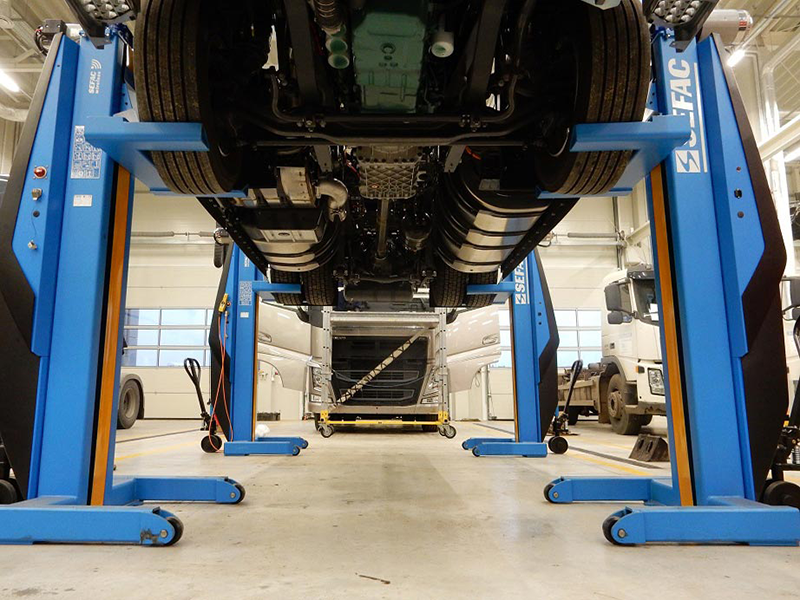
This is why many workshops invest in mobile column lifts and other heavy-duty lifting systems. They allow technicians to raise large vehicles to an ergonomic working height, gain full access to the chassis, drivetrain, wheels, brakes, suspension, and underbody components, and complete jobs with fewer physical constraints. SEFAC designs and manufactures heavy-duty lifting solutions for road and rail maintenance, including mobile column lifts for heavy vehicles. The company states that its road range is the result of more than 60 years of research and innovation, with patented technologies in France and abroad.

What are big truck lifts?
Big truck lifts are heavy-duty lifting systems designed to raise large commercial vehicles safely during maintenance, inspection, and repair. They are used for trucks, buses, coaches, municipal vehicles, military vehicles, industrial vehicles, forklifts, and special-purpose equipment. Unlike light-duty automotive lifts, these systems are engineered for much higher loads, larger wheelbases, heavier axles, and more demanding workshop cycles.
The most common solution for flexible heavy-duty maintenance is the mobile column lift. Each column is positioned at a wheel, and the columns operate together to raise the vehicle in a synchronized way. Depending on the vehicle and the application, workshops may use four, six, or eight columns. This makes the equipment suitable for many configurations, from standard trucks to articulated buses and special vehicles.
SEFAC’s heavy-duty lifting range includes equipment for road vehicles, rail vehicles, forklifts, and special vehicles. Its US website describes the company as a manufacturer of mobile vehicle lifts offering a wide range of lifting solutions for maintenance project needs. This matters because a fleet workshop rarely maintains one vehicle type only. It needs adaptable equipment that can evolve with its workload.
The performance benefits of big truck lifts
The first performance benefit of big truck lifts is access. When a vehicle is lifted to a comfortable height, technicians can work faster and with better visibility. Brake jobs, suspension work, axle inspections, driveline repairs, exhaust system checks, and underbody diagnostics all become easier to perform. This reduces wasted motion and improves job quality.
The second benefit is workflow flexibility. Mobile column lifts do not permanently occupy a fixed bay in the same way as some installed systems. They can be moved, stored, and redeployed according to the day’s workload. This is useful for workshops that must handle mixed fleets, seasonal demand, urgent repairs, or vehicles with different wheelbases and axle layouts.
The third benefit is lifting capacity. SEFAC’s 10-ton-per-column models, for example, are designed for heavy-duty vehicles, with configurations of 2, 4, 6, or 8 connected columns depending on the operation. SEFAC indicates that the 1200M100 and 1600M100 columns are suitable for vehicles up to 40 tons, with a lifting height of 1,820 mm and lifting speed of 680 mm/min.
For a maintenance manager, these numbers translate into practical value. The lift must raise the vehicle high enough, fast enough, and safely enough to support real workshop productivity. Performance is not only about maximum capacity. It is about repeatable daily use.
How big truck lifts save time in heavy-duty maintenance
Time savings come from three areas: setup, access, and job completion. A well-designed mobile column lift allows technicians to position columns around the vehicle without complex civil works or fixed infrastructure. Once the columns are in place, the vehicle can be raised to the correct height for the task.
This directly reduces the time technicians spend crawling under vehicles, using pits, repositioning jacks, or creating temporary access. A lifted vehicle gives better clearance and more working freedom. Therefore, tasks that usually require awkward movements can be completed more efficiently.
The time savings also extend to multi-technician work. When the full vehicle is raised, one technician can work on brakes while another inspects suspension components or underbody systems. In a busy workshop, this can improve throughput without expanding the building.
This is where big truck lifts become a business decision. A lift does not only raise steel. It raises the productivity of the entire bay. If a workshop can complete more jobs per week, reduce vehicle downtime, and release assets back to service faster, the equipment begins to affect revenue, fleet availability, and customer satisfaction.
Productivity gains for fleets, dealerships, and service centers
For fleets, productivity means keeping vehicles available. A delivery truck waiting in the shop is not generating value. A bus out of service affects schedules. A municipal vehicle delayed in maintenance may create operational pressure. In every case, downtime has a cost.
For dealerships and independent repair centers, productivity is tied to billable hours, bay turnover, and customer trust. If the lift helps technicians perform more work safely and efficiently, the shop can absorb more maintenance volume without immediately hiring more staff or expanding its footprint.
The productivity advantage of big truck lifts is especially strong in mixed-use workshops. A single day may include a tractor unit, a rigid truck, a bus, a trailer, and a special-purpose vehicle. Mobile column lifts allow the workshop to adapt quickly to each vehicle instead of forcing every task into a rigid layout.
SEFAC positions its heavy-duty lifting solutions around robust, intuitive, and durable mobile column lifts built to maximize daily productivity. That message aligns with what workshop managers care about most: predictable performance, simple operation, and less wasted time between jobs.
Safety as a productivity multiplier
Safety is often treated as a compliance requirement, but in heavy-duty maintenance it is also a productivity multiplier. A safer lifting system reduces hesitation, improves technician confidence, and supports repeatable workshop processes. When technicians trust the equipment, they can focus on the repair.
Heavy vehicles create serious lifting risks because of their mass, height, and complex weight distribution. For that reason, big truck lifts must be designed around load control, synchronization, mechanical safety, and operator protection. Features such as deadman controls, obstacle detection, controlled lifting, and secure holding systems are not optional extras. They are central to performance.
SEFAC’s 10-ton column lift page highlights several safety-related features, including an irreversible system designed to prevent falling risk, deadman’s control, obstacle detection, and IP54 electrical protection. These details are important because they show how engineering choices support day-to-day workshop confidence.
A safety-focused lift can also reduce indirect costs. Incidents, near misses, equipment damage, and unsafe workarounds all interrupt operations. By improving the lifting process, a workshop improves both safety culture and business continuity.
Choosing the right big truck lifts for your workshop
Choosing big truck lifts starts with the vehicles you maintain today and the vehicles you expect to maintain tomorrow. The right lift must match axle loads, tire diameters, wheel configurations, vehicle lengths, workshop space, power supply, and service frequency.
A fleet workshop should ask whether it needs wired or wireless operation, how many columns are required, what lifting height is suitable, and how easily technicians can maneuver the columns. It should also evaluate service access, spare parts, training, and future scalability.
Capacity must be considered carefully. It is not enough to know the gross vehicle weight. The buyer should understand axle load distribution, lifting points, wheel dimensions, and the heaviest real-world configuration. This is especially true for special-purpose vehicles, fire trucks, airport vehicles, military vehicles, and vehicles carrying permanent equipment.
SEFAC offers multiple categories of road lifting equipment, including wireless column lifts, mobile column lifts, column lifts for forklifts, ancillaries, and road accessories. This breadth supports a more precise equipment choice. Instead of buying a generic lift, workshops can select a lifting solution suited to their real maintenance operations.
Why mobile column lifts are often the preferred solution
Mobile column lifts are popular because they combine capacity, access, and flexibility. They can support daily truck maintenance without forcing the workshop into one fixed lifting bay. For facilities where space is limited, this flexibility is valuable.
They also support different work patterns. A technician can lift one vehicle for an inspection, then move the columns to another bay for a larger repair. If the workshop handles buses one day and trucks the next, the same equipment can often be adapted with the right configuration.
The business benefit is resilience. Fixed infrastructure can be highly effective, but it may limit how a shop responds to changing workloads. Mobile big truck lifts give managers more options. In a market where vehicle types, maintenance schedules, and fleet demands change quickly, operational flexibility has real economic value.
This is especially relevant for heavy-duty service providers, public transport operators, logistics fleets, construction fleets, and municipal workshops. These organizations need equipment that works hard every day, but also adapts when the schedule changes.
Final answer: big truck lifts are performance equipment, not just lifting equipment
Big truck lifts should be viewed as performance equipment. They influence technician efficiency, vehicle downtime, workshop safety, operating costs, and return on investment. For heavy-duty maintenance businesses, the right lifting system can unlock faster workflows, better access, lower fatigue, and stronger bay productivity.
The best choice is not always the largest lift or the cheapest lift. It is the lifting solution that matches the workshop’s vehicles, workload, safety expectations, and growth plans. That is why capacity, synchronization, manoeuvrability, service support, and lifecycle cost must all be considered before buying.
For fleets, dealerships, transit operators, and heavy-duty repair centers, investing in reliable big truck lifts is a direct investment in uptime. With its experience in mobile column lifts and heavy-duty lifting solutions, SEFAC offers a credible technical partner for workshops that want to improve maintenance performance while controlling long-term operating costs.
FAQ
What are big truck lifts used for?
Big truck lifts are used to raise heavy commercial vehicles during maintenance, inspection, and repair. They help technicians access brakes, axles, suspension, drivetrains, underbody systems, and other components safely and efficiently. They are commonly used for trucks, buses, coaches, trailers, municipal vehicles, forklifts, and special-purpose vehicles.
Are mobile column lifts good for heavy-duty workshops?
Yes. Mobile column lifts are well suited to heavy-duty workshops because they offer flexibility, capacity, and full underbody access. They can be moved between bays, configured for different vehicle lengths, and used for mixed fleets. This makes them especially useful for shops that maintain several vehicle types.
How do big truck lifts improve ROI?
They improve ROI by reducing maintenance time, improving bay utilization, lowering vehicle downtime, and helping technicians work more efficiently. They may also reduce outsourcing costs and support better first-time repair quality. The payback depends on usage frequency, labor rates, fleet size, and the cost of downtime.
What should I consider before buying big truck lifts?
Key factors include lifting capacity, number of columns, vehicle types, tire diameters, workshop layout, safety features, power requirements, service support, training, and total cost of ownership. Buyers should evaluate both current maintenance needs and future fleet evolution.
Why choose SEFAC for big truck lifts?
SEFAC designs and manufactures heavy-duty lifting solutions for road and rail maintenance. The company offers mobile column lifts, road lifting equipment, accessories, and technical support. Its industrial positioning focuses on robust, durable, and productivity-oriented lifting systems for demanding workshops.